
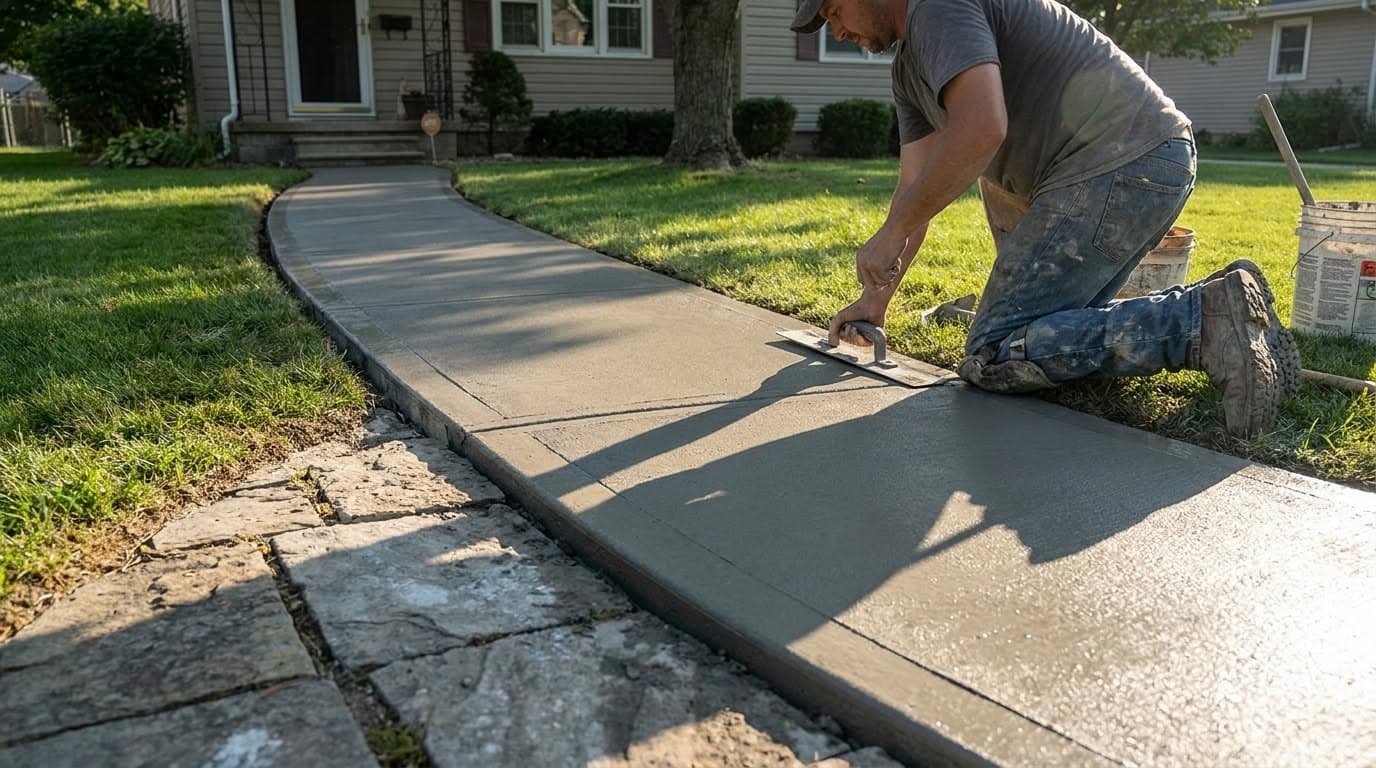
Crumbling front steps are one of those problems that starts small and gets worse fast. A chip here, a crack there, and before long the edges are flaking off and the riser heights are uneven. That uneven step is a trip hazard every single time someone walks up to your door. And in the Metro East, where freeze-thaw cycles work on concrete every winter, a small crack in a stoop rarely stays small.
Replacing steps or a front stoop isn't something most homeowners can put off indefinitely. Sooner or later the concrete tells you it's done.
Our Approach to Concrete Steps and Stoops
Not all steps fail because of bad luck. Most fail because they weren't formed and poured right the first time. Steps need a properly prepared base, the right form work to hold the riser and tread dimensions, and concrete that's finished to shed water instead of hold it.
We form and pour steps and stoops from scratch. That means we pull out the old concrete, prep the area underneath, set forms to the correct riser heights and tread depths, and pour to code. The finished product is level, drains properly, and has a clean edge that won't chip off after the first hard freeze.
What sets this work apart is what happens below the surface. If the base under your old steps settled or washed out over the years, new concrete poured on top of that same base will do the same thing. We address the grade and compaction under the slab before the forms go in, so your new steps are sitting on something solid.
We use our own trucks and equipment, so we handle the demolition and haul-away of the old steps in-house. You don't call a separate demo company. The same crew that tears it out pours the replacement.
When You Need New Concrete Steps or a Stoop
A few scenarios we see regularly across the service area:
Crumbling edges and spalling surfaces. Steps that were poured thin or finished in bad conditions tend to scale and flake after a few winters. Once the surface layer goes, water gets into the concrete and the cycle speeds up.
Settled or sunken steps. If the step at the bottom of your stoop sits noticeably lower than it used to, the base has moved. That's a tripping hazard, and it usually means the fix isn't just cosmetic.
Uneven riser heights. Steps that have shifted or were never poured correctly end up with inconsistent riser heights. That's how people get hurt, especially after dark or when carrying something.
Cracked or heaved stoops. A single large crack across a stoop slab usually means freeze-thaw movement or tree root pressure lifted the slab. Patching over a cracked stoop rarely holds long-term. Replacement makes more sense than a patch that fails again in two winters.
What's Included in a Steps and Stoop Job
Here's how a typical project runs:
Site visit and estimate. We come out, look at the existing steps, measure the entry area, and talk through your options. If there's a landing or railing involved, we factor that in. The estimate is free and written.
Removal. We break out the old steps or stoop and haul everything away. No debris left on your property.
Base prep. We check the grade and compact the base. If fill is needed to get the right elevation, we take care of it before the forms go in.
Form work. Forms are set to the right riser and tread dimensions. This step determines how your finished steps look and function. We take time here.
Pour and finish. Concrete is poured, consolidated, and finished with a broom texture for traction. Edges are tooled for a clean, durable profile.
Curing. We cover or treat the surface during curing to give the concrete the time it needs, especially important in warm or dry conditions.
You'll know when you can use the steps again. We give you clear guidance before we leave.
What to Expect on Cost
Step and stoop replacement pricing varies based on a few things: how many steps, the width of the stoop, whether a landing or sidewalk connects to it, and what's involved in the removal. A small two-step entry costs less than a full front stoop with a wide landing and a long run down to the sidewalk.
We don't quote steps over the phone without seeing the job. The details matter too much to guess. What we can tell you is that a free on-site estimate will give you a real number, not a range designed to get your foot in the door.
If your project connects to a walkway or sidewalk, we can quote that at the same time. Doing related flatwork in one pour often saves time and keeps the finished work looking consistent.
Call us at 618-280-3200 or reach out through the estimate form to set up a time.
Where We Work
We pour concrete steps and stoops throughout St. Clair, Madison, and Monroe County. That covers O'Fallon, Belleville, Shiloh, Swansea, and Fairview Heights in St. Clair County; Edwardsville, Collinsville, Glen Carbon, and Troy in Madison County; and Waterloo and Columbia in Monroe County.
See all the towns we cover on our St. Clair County, Madison County, and Monroe County service area pages.
If you're in one of the smaller surrounding towns and aren't sure whether we come out your way, give us a call. We work across a wide area and Belleville is right in the middle of it.
Related Services
If your front steps project connects to other flatwork around your home, here are the services that commonly go together:
Concrete Sidewalk Installation - New sidewalks and walkways to connect your steps to the street or other areas of your property, poured level and built for daily use.
Concrete Walkway / Path - Connecting your front stoop to a driveway or around to the back of the house. Standard or decorative finishes available.
Concrete Patio Installation - If you're replacing steps off a back door that leads to a patio, we can quote both in one visit.
Stamped Concrete Patio - Looking to upgrade the entry area with a decorative finish? Stamped concrete works on landings and patios connected to steps.