
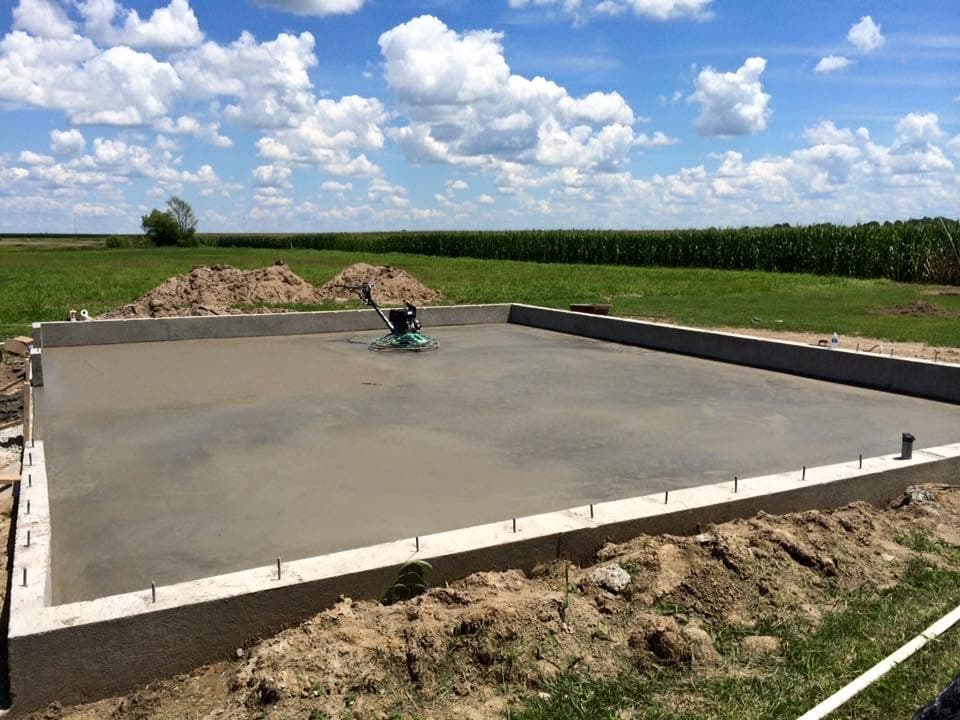
A garage or shop floor takes more punishment than almost any other slab on a property. Vehicles, heavy equipment, oil, road salt tracked in from Illinois winters — a floor that was poured too thin or on a poorly prepped base shows those problems fast. Cracks spread, the surface dusts and flakes, water pools in low spots. Once that starts, the floor doesn't get better on its own.
We pour garage and shop floors across the Metro East for homeowners, hobby shops, agricultural buildings, and small commercial operations. The work is straightforward when it's done right. It gets expensive when it's not.
Our Garage & Shop Floor Approach
The difference between a floor that lasts twenty years and one that starts cracking in three usually traces back to two things: base preparation and slab thickness.
We start by grading and compacting the base. A flat, stable, well-drained sub-base is what the concrete actually rests on. If the base settles unevenly, the slab cracks. We handle that prep in-house rather than relying on whoever shows up with a skid steer.
Thickness matters because of load. A standard residential garage floor that parks two cars every day needs to be spec'd for that. A shop floor that sees a loaded truck, a tractor, or heavy fabrication equipment needs more. We discuss what you're using the space for before we pour, so the slab is built for the actual load, not a generic residential minimum.
Reinforcement is part of the conversation too. Wire mesh or rebar, depending on the application and what the ground conditions call for. After the pour, we finish the surface flat so it drains correctly and doesn't leave you pushing water around with a broom.
We run our own trucks. That matters on garage and shop jobs because we're not waiting on outside haulers for concrete delivery or material removal. One crew handles the job from prep to pour to cleanup.
When You Need a New Garage or Shop Floor
The existing floor is cracking and breaking apart. Cracks in a garage floor tend to start small and widen over time, especially with Illinois freeze-thaw cycles. Once the sub-base settles unevenly, patching the surface is a short-term fix. At some point, replacement is the right call.
You're building a new garage, pole barn, or outbuilding. New construction needs a floor poured before it becomes the foundation for everything else in the building. Getting the thickness and base prep right at the start costs less than fixing problems after the building goes up.
The floor isn't level and water isn't draining. Water pooling on a garage floor means the surface pitch was off when it was poured or the slab has shifted. This creates ongoing moisture problems and can affect anything stored or worked on in that space.
You're converting a shop or adding equipment. A floor poured for a light residential garage may not handle heavier loads. If you're adding a lift, welding equipment, or moving to a commercial-type operation in an outbuilding, it's worth a conversation about whether the existing slab is adequate.
Our Process
1. Free on-site estimate. We come out, look at the space, talk through what the floor needs to handle, and measure the square footage. If there's an existing slab to remove, we price that in.
2. Demo and haul-away (if replacing). If the old floor is coming out, we handle that with our own crew and trucks. You don't have to line up a separate demolition or hauling company. The debris is loaded and gone before the base prep starts.
3. Base prep and grading. We grade and compact the sub-base so the slab has a solid, level foundation. Proper drainage slope is set at this stage.
4. Form work and reinforcement. Forms go in at the correct dimensions. Reinforcement, mesh or rebar, is placed per the application and load requirements.
5. Pour and finish. Concrete is poured, struck off, and finished flat with the appropriate surface texture. We time the pour and finishing to the weather conditions.
6. Curing. We give you specific guidance on how long to stay off the floor. Foot traffic is usually fine within a day or two. Vehicles typically wait about a week. Heavy equipment needs longer, and we'll tell you what applies to your pour.
What to Expect on Cost
Garage and shop floor cost depends on a few variables: square footage, slab thickness, whether existing concrete needs to be removed first, and the ground conditions we're working with.
A straightforward pour for a standard two-car garage will land in a different range than a large shop floor built for heavy equipment, because the material and prep requirements are different. We don't quote a flat per-square-foot number without seeing the project, because that number doesn't account for what's under the ground or what the floor actually needs to handle.
The estimate is free. We come out, look at the space, and give you a clear price before any work starts. No guessing, no adjusting the number after the job is underway.
Call us at 618-280-3200 or reach out through the contact page to set up a time.
Where We Work
We pour garage and shop floors across St. Clair, Madison, and Monroe County. A few of the areas we work in regularly:
- O'Fallon, IL - O'Fallon service area
- Belleville, IL - Belleville service area
- Edwardsville, IL - Edwardsville service area
- Collinsville, IL - Collinsville service area
- Waterloo, IL - Waterloo service area
- Columbia, IL - Columbia service area
We also work in Troy, Glen Carbon, Fairview Heights, Swansea, Mascoutah, Highland, and the surrounding towns. If you're not sure whether we cover your area, call us. If we can get there, we will.
See the full service area map for more detail.
Related Services
Concrete Slabs & Pads Slabs for sheds, AC units, hot tubs, and equipment pads. Sized and reinforced for the load, poured level.
Concrete Removal & Replacement Full tear-out and replacement in one stop. We demolish the old slab, haul it off with our own trucks, prep the base, and pour new concrete.
Commercial Concrete Flatwork Concrete flatwork for businesses including pads, approaches, and ADA-accessible surfaces. Scheduled to limit disruption.
Stamped & Decorative Concrete Stamped, colored, and stained finishes for patios, driveways, and walkways. The look of stone or brick with the durability of concrete.